

Login / Înregistrare
ÎN GRABĂ? FOLOSEȘTE:

sau email

Utilizator nou

Ai pierdut parola?
Produse 
Produse 
  • 
      Login
      Librării
      Login
      Coșul tău
      Total RON Finalizare comandăComandă
      x
      
      Nu aveți produse în coș.
      Finalizare comandăComandă
      • carturesti.ro
      • Why We Cooperate
      „Why We Cooperate”  în librăriile Cărturești
      Indisponibil în .
      Puțintică răbdare...
      Unde ne găsești
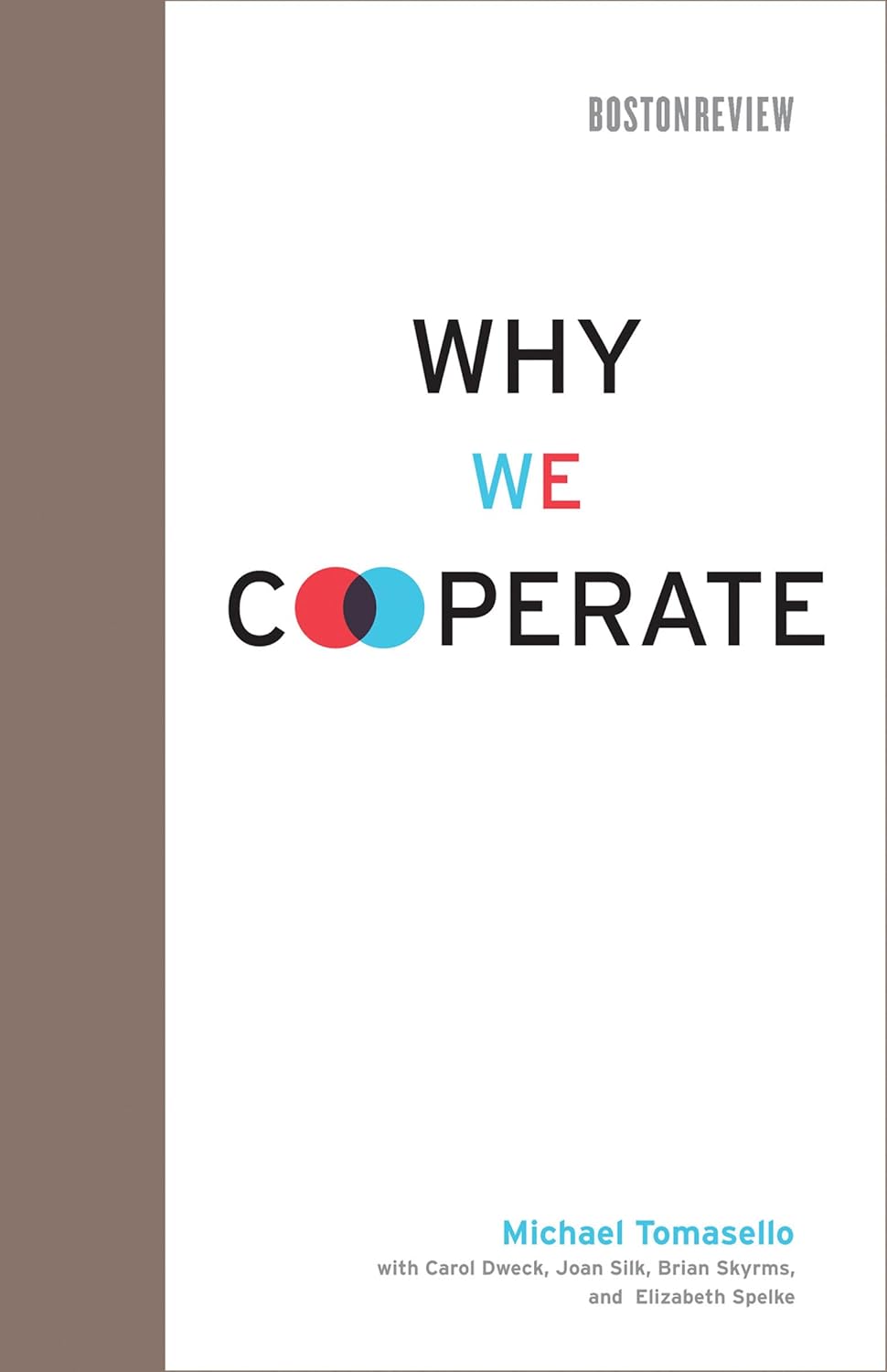
      Why We Cooperate

      Why We Cooperate

      Michael Tomasello
      0.0 / 10 ( 0 voturi)

      Categorii:
      Psihologia copilului si dezvoltarii
      Limba:
      Engleza
      Data publicării:
      2026
      Editura:
      MIT Press
      Tip copertă:
      Paperback
      Nr Pag:
      232
      Colectie:
      Boston Review Books
      ISBN:
      9780262053945
      Dimensiuni: l: 11.4cm | H: 17.8cm | 1.8cm | 156g
      Adaugă în coș
      Adaugă în wishlist

      S-ar putea să-ți placă și:
      The Cultural Origins of Human Cognition
      Michael Tomasello
      login
      Natural History of Human Thinking
      Michael Tomasello
      login
      No-Drama Discipline
      Daniel J. Siegel, Tina Payne Bryson
      login
      The Wiley Handbook of What Works With Adolescents Who Have Offended
      Calvin M. Langton, James R. Worling
      login
      Descriere

      Understanding cooperation as a distinctly human combination of innate and learned behaviour. Drop something in front of a two-year-old, and she's likely to pick it up for you.

      This is not a learned behavior, psychologist Michael Tomasello argues. Through observations of young children in experiments he himself has designed, Tomasello shows that children are naturally—and uniquely—cooperative. Put through similar experiments, for example, apes demonstrate the ability to work together and share, but choose not to. As children grow, their almost reflexive desire to help—without expectation of reward—becomes shaped by culture. They become more aware of being a member of a group. Groups convey mutual expectations, and thus may either encourage or discourage altruism and collaboration.

      Either way, cooperation emerges as a distinctly human combination of innate and learned behavior. In Why We Cooperate, Tomasello's studies of young children and great apes help identify the underlying psychological processes that very likely supported humans' earliest forms of complex collaboration and, ultimately, our unique forms of cultural organization, from the evolution of tolerance and trust to the creation of such group-level structures as cultural norms and institutions. Scholars Carol Dweck, Joan Silk, Brian Skyrms, and Elizabeth Spelke respond to Tomasello's findings and explore the implications.

      Recenzii și comentarii

      Nota

      de |

      Nu există recenzii pentru acest produs.
      • Termeni & condiții
      • Politică Cookie-uri
      • ANPC
      © Carturesti 2026 | ® Conținut cu drepturi protejate
      Personalizează